
“ABA causes PTSD.” “ABA is completely safe.” I hear both from families and from colleagues, and neither matches what the research currently shows.
A large 2026 study has brought the question back into the open. Here is what it found, what it cannot tell us, and what to do with that.
What the 2026 study found
Aguirre Mtanous and colleagues (2026) used United States private insurance records from 2012 to 2020. They matched 17,120 autistic young people who had applied behavior analysis billed to insurance with 17,120 similar autistic young people who did not, then compared three outcomes: post-traumatic stress disorder diagnoses, suicidality, and mental health hospitalizations.
On PTSD and suicidality there was no statistically significant difference between the groups.
On mental health hospitalization there was. It occurred in 408 young people in the ABA group, about 2.4 percent, against 341 in the matched group, about 2.0 percent. After adjustment the odds were roughly 30 percent higher.
That 30 percent is the figure traveling through social media, and it needs context. In absolute terms the difference is about 0.4 percentage points, or about four more children per thousand. The study also found that receiving more ABA was not associated with worse outcomes on any measure.
Why this is not evidence that ABA caused harm
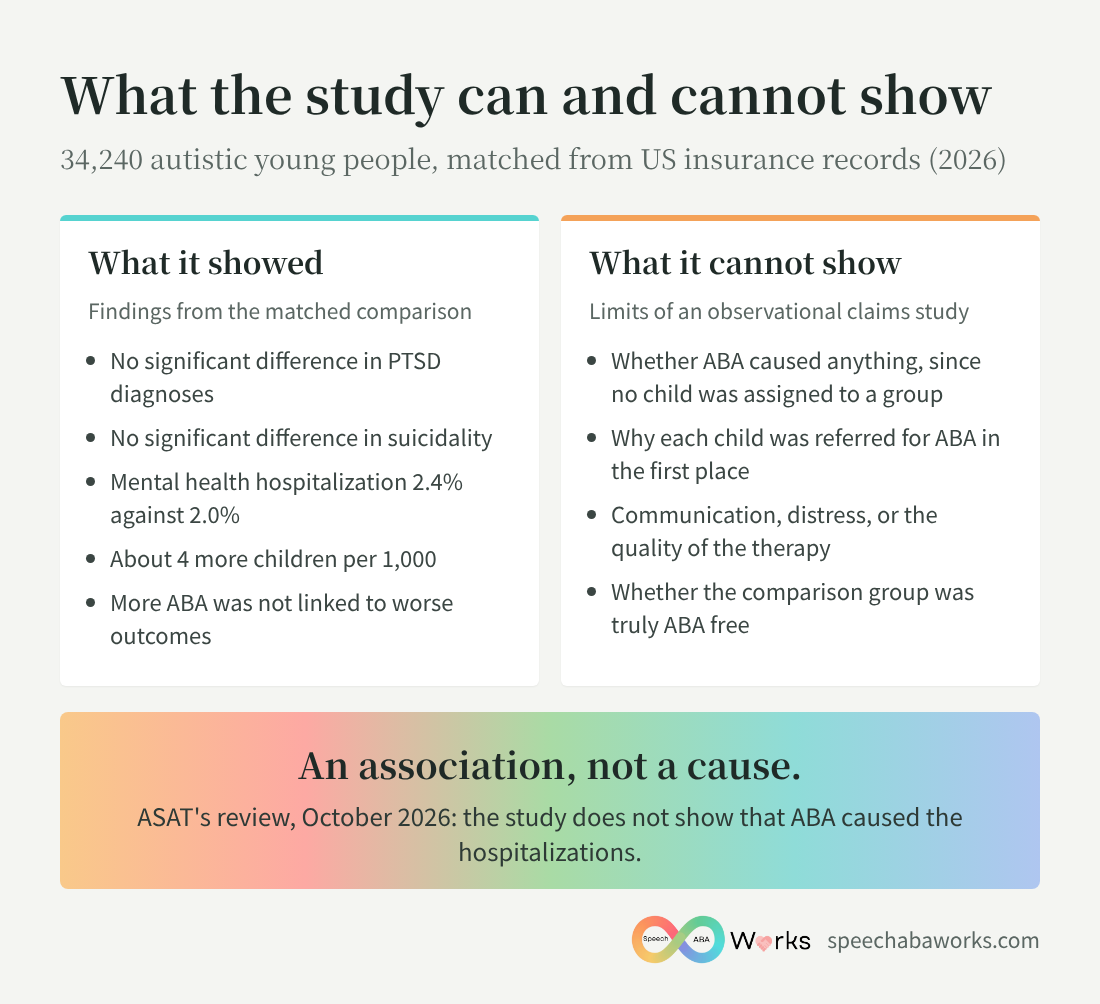
This was an observational study built from billing records. No child was assessed directly, and no one was assigned to a group. The Association for Science in Autism Treatment reviewed it in October 2026 (Eikeseth, Green, and Larsson, 2026) and set out the limits plainly.
Confounding by indication. The reasons a child is referred for ABA, including higher support needs and co-occurring conditions, may themselves raise the chance of a psychiatric admission. When the reason for treatment also predicts the outcome, the association tells you very little.
Claims data cannot see the child. Insurance records hold no measure of communication, distress, family circumstances, or the quality of the therapy, and no record of whether it was delivered as designed.
The comparison group is not ABA free. Children with no ABA claims may have received ABA through school or private pay, which blurs any real difference between the groups.
The reviewers’ own conclusion is more careful than most of the coverage: “It does not show that ABA caused mental health hospitalizations.” It is a question raised, not a verdict reached.
The older claim that ABA causes PTSD
Most of the online argument does not rest on the 2026 study at all. It rests on a 2018 survey reporting an association between exposure to ABA and post-traumatic stress symptoms, shared very widely since.
Quinton and colleagues (2024) appraised that study, and a later analysis of the same data, within a systematic review of PTSD in autistic people. On a standard quality checklist they scored both at 2 out of 8, the weaknesses sitting in the clarity of the analysis and the presentation of the statistics, and advised caution before drawing conclusions about ABA and PTSD from it.
So the most-cited evidence for the strong claim is methodologically weak. That should be said plainly by people inside the field, not only by its defenders.
“No evidence of harm” is not “proven safe”
This is where I part company with the more confident versions of the pro-ABA argument.
Harms are barely measured. Bottema-Beutel and colleagues (2021) examined 150 reports of early autism intervention research and found 11, about 7 percent, that mentioned adverse events at all, none with a systematic procedure for monitoring them. You cannot find what you never look for, and a field that does not measure harm is not entitled to claim its absence. This is true across early intervention research, not in ABA alone.
PTSD is easy to miss in autistic people. Trauma-related difficulties are often attributed to autism itself rather than recognized as trauma, a pattern called diagnostic overshadowing (Quinton et al., 2024). An under-identified condition will be undercounted by any study counting diagnoses.
Autistic adults are describing something real. McGill and Robinson (2021) interviewed ten autistic adults about childhood ABA, and the accounts were largely of harm. Ten people cannot tell us how common that is, and the study was never designed to. What they tell us is what the outcome measures have been missing, and dismissing them for a small sample is a misuse of the word evidence.
Holding both halves at once is uncomfortable, and it is also the accurate position. Current research does not show that ABA causes PTSD. Current research is also not good enough to declare it harmless.
The question that actually helps a child
For a parent choosing services, “does ABA work” is the wrong question, because ABA is not one thing. The useful question is whether this program, for this child, is building something worthwhile without causing distress.
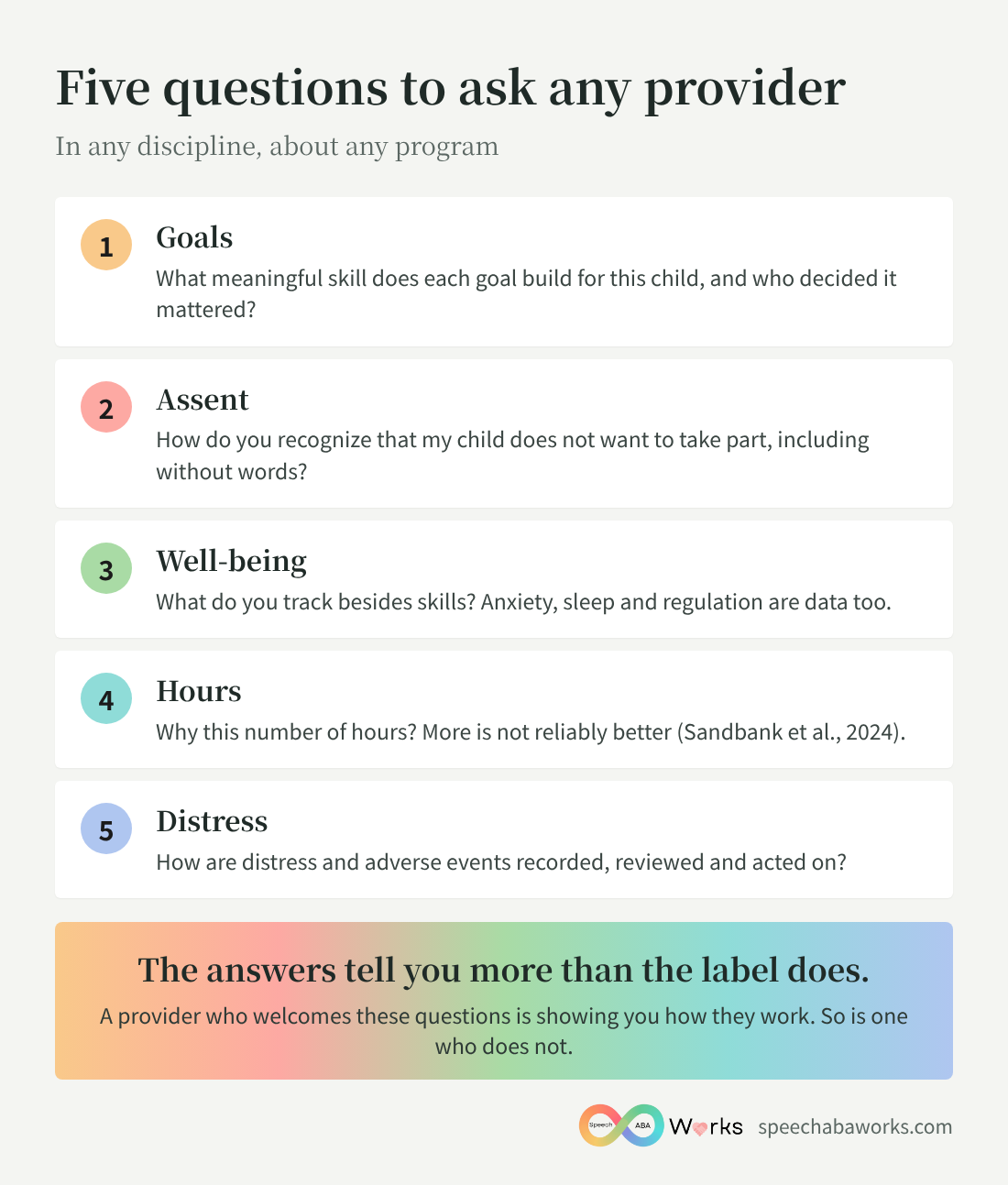
Five things worth asking any provider, in any discipline:
Goals. What meaningful skill does each goal build for this child, and who decided it mattered?
Assent. How do you recognize that my child does not want to take part, including when they communicate that without words, and what happens when you see it?
Well-being. What do you track besides skill acquisition? Anxiety, sleep, and emotional regulation are data too.
Hours. Why this number of hours? Sandbank and colleagues (2024) analyzed 144 studies covering 9,038 autistic children and found no reliable association between the amount of intervention and the size of the gains. A recommendation of twenty-five or forty hours per week needs a reason specific to your child, not a convention.
Distress. How are distress and adverse events recorded, reviewed, and acted on?
A provider who welcomes these questions is showing you something about how they work. So is one who does not.
Both of my fields have depth the other does not. Speech-language pathologists hold the content knowledge about communication and what a child is actually able to express, including the difference between a child who will not and a child who cannot. Behavior analysts hold the science of learning and how behavior interacts with the environment, including why a child who is distressed stops learning. When those two sit in the same plan from the start, assent and well-being stop being add-ons and become part of how the program is built.
Frequently asked questions
Does ABA cause PTSD?
Current research does not show that it does. The largest study to date, covering 34,240 autistic young people, found no significant difference in PTSD diagnoses between those who received ABA and those who did not (Aguirre Mtanous et al., 2026), and the most widely shared study supporting the claim has been rated as low quality (Quinton et al., 2024). That is not the same as proof of safety, because harms have rarely been measured.
What did the 2026 study actually find?
No significant difference in PTSD or suicidality, and a small difference in mental health hospitalization, 2.4 percent compared with 2.0 percent. More ABA was not linked to worse outcomes. Because it used insurance records rather than direct assessment, it cannot establish cause.
Is ABA safe for my autistic child?
That question has no yes or no answer, and a confident answer in either direction is usually too surface-level to be useful.
ABA is a science, a set of principles about how learning and behavior work. A science is not in itself abusive. What can be abusive is the way it gets applied, and some of what was done in its name decades ago was. As the science has developed, so have practitioners’ methods and their beliefs about what is acceptable, which is why a program run today by a clinician who keeps up looks very different from one run in 1985.
So the name of the approach tells you little. Ask how the team recognizes and responds to your child’s distress. Ask what they track besides skill acquisition. Ask how your child’s assent is protected, including when your child communicates without words. Those answers will tell you more about whether your child is safe than any label will.
Why do so many autistic adults say ABA harmed them?
Because some of them were harmed. Practices that were common decades ago, including compliance-focused programs and the use of aversives, are not what good practice looks like now, and accounts like those gathered by McGill and Robinson (2021) describe real experiences. Those accounts should shape how services are delivered, whether or not group studies have caught up with them.
How many therapy hours does my child need?
Fewer than the field has traditionally assumed, on current evidence. A meta-analysis of 144 studies found no reliable link between more hours and better outcomes (Sandbank et al., 2024). The number should follow from your child’s goals and tolerance, and it should be revisited.
This article is general information and is not a substitute for individual assessment or advice about your child. If you have concerns about your child’s mental health, speak to their doctor or a qualified mental health professional.
If you are weighing services for your child, or building assent-based practice into a team, I offer consultations for families and professionals. You may also want to read my earlier post, Is ABA Good or Bad? An SLP and BCBA Answers, which covers the broader debate.
I share shorter versions of these ideas as @speechabaworks on Threads and Instagram.
Selected references
- Aguirre Mtanous, N. G., Koenig, J., Nikahd, M., Effertz, S. E., Silinonte, S., Hyer, J. M., Hand, B. N., & Bishop, L. (2026). Mental health outcomes associated with applied behavior analysis in a US national sample of privately insured autistic youth. Autism, 30(2), 484–494.
- Eikeseth, S., Green, G., & Larsson, E. (2026). Research synopsis of Aguirre Mtanous et al. Science in Autism Treatment, 23(10). Association for Science in Autism Treatment.
- Quinton, A. M. G., Ali, D., Danese, A., Happé, F., & Rumball, F. (2024). The assessment and treatment of post-traumatic stress disorder in autistic people: A systematic review. Review Journal of Autism and Developmental Disorders. Advance online publication.
- Bottema-Beutel, K., Crowley, S., Sandbank, M., & Woynaroski, T. G. (2021). Adverse event reporting in intervention research for young autistic children. Autism, 25(2), 322–335.
- Sandbank, M., Pustejovsky, J. E., Bottema-Beutel, K., Caldwell, N., Feldman, J. I., Crowley LaPoint, S., & Woynaroski, T. (2024). Determining associations between intervention amount and outcomes for young autistic children: A meta-analysis. JAMA Pediatrics, 178(8), 763–773.
- McGill, O., & Robinson, A. (2021). “Recalling hidden harms”: Autistic experiences of childhood applied behavioural analysis (ABA). Advances in Autism, 7(4), 269–282.