
“He has been in speech therapy for two years. He knows exactly what he wants to say. The same word comes out differently every single time, and now he will not even try.”
I hear this from parents of children with childhood apraxia of speech more often than almost anything else, and the two halves of that sentence are connected. The inconsistency is the disorder. The refusal is what the disorder produces when practice becomes the hardest thing a child does all week.
Apraxia therapy is unusual among speech and language interventions because the amount of practice matters as much as the content of it. That single fact explains most of what goes wrong, and most of what fixes it.
What childhood apraxia of speech actually is
Childhood apraxia of speech is a motor planning and programming disorder. The child knows the word. The muscles are not weak. What breaks down is the brain’s plan for sequencing the movements that produce the word, so the same target comes out differently on different attempts.
Several features distinguish it from a phonological delay or an articulation difficulty:
- Errors are inconsistent across repetitions of the same word.
- Longer words and longer phrases are disproportionately harder than short ones.
- Transitions between sounds and syllables are effortful, and you can often see the child searching for the position.
- Prosody, meaning the rhythm and stress of speech, is frequently affected.
- Understanding is typically far ahead of speech production.
That last point matters enormously for how a child experiences therapy. A child with apraxia usually understands everything being said about the difficulty, and knows precisely how far the attempt fell short of the intention.
Why apraxia needs so much practice
Motor speech disorders respond to the principles of motor learning, which are the same principles that govern learning to play an instrument or a sport. The research base points consistently in one direction: frequent, accurate repetition of well chosen targets, with feedback that changes as the skill develops.
Three of those principles shape a good apraxia session:
- Practice amount. High numbers of trials produce change. Low numbers do not, regardless of how skilled the therapist is.
- Practice distribution. Shorter sessions held more often generally outperform a single long weekly session, because motor learning consolidates between practices.
- Feedback schedule. Early in learning, specific feedback about how the movement was produced helps the child adjust. Later, that feedback is deliberately reduced so the child learns to judge their own accuracy rather than waiting to be told.
None of this is controversial among speech-language pathologists. The difficulty is not knowing what apraxia therapy requires. The difficulty is getting a child to tolerate it.
What DTTC looks like in a session
Dynamic Temporal and Tactile Cueing, usually shortened to DTTC, is one of the better researched treatments for childhood apraxia of speech. It was developed by Edythe Strand, and it is built for precisely the problem apraxia presents: the child needs help producing an accurate movement, and then needs that help withdrawn quickly enough that the movement becomes their own.
The name describes what the therapist adjusts. Temporal refers to timing, so the word is practiced slowly at first and then brought gradually up to a normal speaking rate. Tactile refers to touch, so the therapist may use a light cue on the child’s jaw, lips or face to guide the movement. Dynamic is the most important word of the three, and it is the part parents most often miss. The amount of support changes continuously, sometimes several times within a minute, according to what the child has just produced.
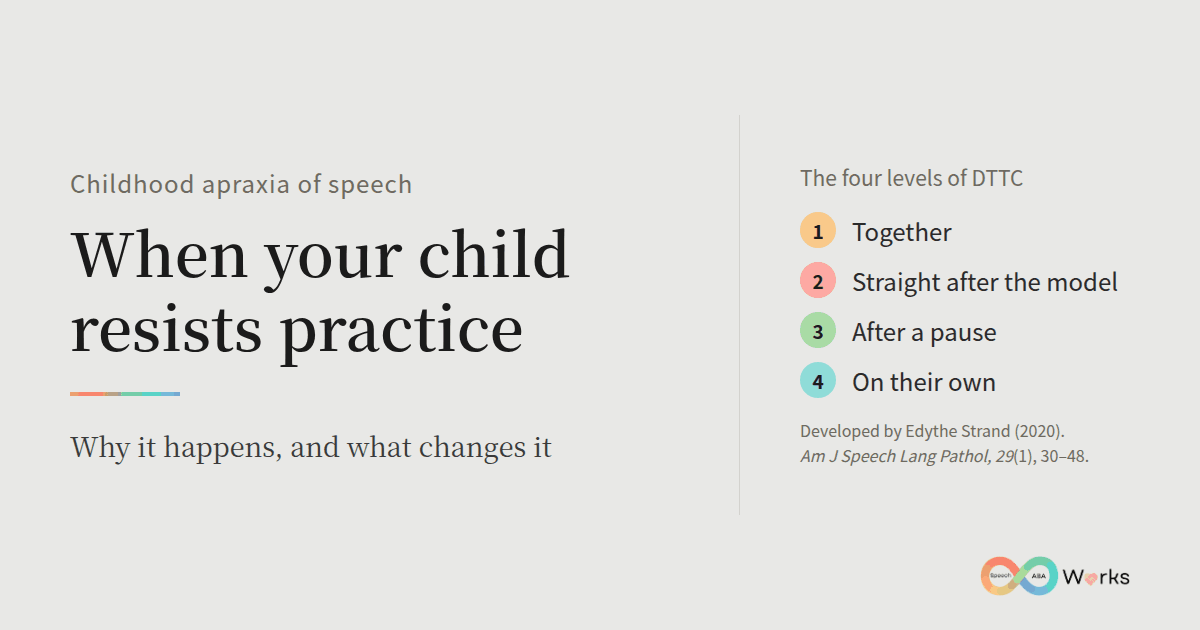
Practice moves through four levels of independence:
- Together. The therapist and the child say the word at the same time, slowly, with the child watching the therapist’s face. Touch cues are added if they help.
- Straight after the model. The therapist says the word and the child repeats it immediately.
- After a pause. The therapist says the word, waits one to three seconds, and then the child produces it. The delay is deliberate, because it asks the child to hold the movement plan in mind rather than copy an echo.
- On their own. The child produces the word with no model at all, prompted only by the situation or a question.
Two features of DTTC explain a great deal of what you will see if you watch a session.
First, the hierarchy is not a ladder the child climbs once. A good session moves up and down it repeatedly. If a word breaks down at the third level, the therapist drops back to the second for a few attempts and then tries again, and none of that counts as failure.
Second, once a word is accurate at a normal rate, the therapist begins varying it: louder, softer, with a different emotion. This is not play for its own sake. Varying the production is what makes the movement flexible enough to survive real conversation.
For a child with severe apraxia, DTTC usually works on a small set of roughly five or six target words at a time, with at least ten attempts at a given level before moving on. Those numbers are the reason the next section matters so much.
The therapeutic conditions that decide whether therapy works
Consider what a twenty minute session actually produces.
A session in which a child is engaged produces a large number of accurate practice attempts. A session in which the same child is avoiding produces a small fraction of that, because most of the time goes somewhere other than practice. The two sessions look identical on the schedule and cost the same, but only one of them is delivering the amount of practice the treatment depends on.
Avoidance in apraxia therapy rarely looks like outright refusal. It looks like a request for the bathroom, a change of subject, a sudden interest in the therapist’s pens, a very long story about something else, or simply going quiet. Each of those behaviors produces a short break from the hardest task of the day, and a break from difficulty is a powerful reinforcer. The child is not being defiant. The child is learning, very efficiently, that certain behaviors end the demand.
This is the point at which a behavioral perspective becomes useful, not as a replacement for speech therapy, but as the thing that makes speech therapy possible.
A case from practice
The details below are a composite, assembled from patterns I have seen many times and changed so that no individual child is identifiable.
A five year old boy with a clear apraxia diagnosis had received weekly speech therapy for two years, delivered using DTTC. He was bright, sociable and increasingly angry. His parents described progress as having stopped, and his therapist described sessions as a negotiation.
The treatment was not the problem. The targets were appropriate, the cueing hierarchy was being applied correctly, and the therapist was skilled. The session was simply not generating enough attempts to drive motor learning, because so much of each block was being spent on negotiation rather than on practice.
The speech-language pathologist and the behavior analyst then worked on the same child at the same time, each bringing the depth of their own training to a different part of the problem.
Who contributed what
| Speech-language pathologist | Behavior analyst |
|---|---|
| Content expertise in speech, language and communication. • Diagnosed the apraxia and ruled out other explanations for the inconsistency • Owns the content area: motor speech planning, phonetic complexity, and how apraxia differs from a phonological delay • Selected and sequenced the target words • Delivered DTTC, including the cueing hierarchy, the tactile cues and the slowed rate • Decided when to fade feedback so the child began judging his own accuracy • Chose the communication system that carried what speech could not yet carry |
Expertise in the science of learning and behavior, and in how behavior interacts with the environment. • Identified what genuinely motivated this child, and rechecked it often, because preferences shift • Applied reinforcement to attempts rather than to accurate productions alone • Pushed for high frequency targets, meaning words the child would use many times a day, so practice continued outside the session • Designed the instruction: block length, pacing, a visible end point, and an activity the child had chosen • Analyzed the avoidance as escape maintained behavior and removed the payoff for it • Built the data system that made the number of attempts visible to everyone |
Three decisions came out of that conversation, and none of them belonged to one profession alone.
The targets were rechosen for value rather than for phonetic tidiness. His brother’s name, “my turn”, “stop”, and the name of his favorite game replaced a list organized by syllable shape. The speech-language pathologist confirmed that each one was achievable given his motor speech profile. The behavior analyst confirmed that each one would be used, and reinforced, many times a day at home.
The practice was rebuilt around motivation. The DTTC trials themselves did not change, but they were delivered inside a game he had chosen, in short blocks with a clearly visible end point.
Attempts were reinforced rather than accuracy alone. This was the single most important change. A child with apraxia will fail on a high proportion of attempts by definition, so a system that rewards only correct productions punishes the child for having the disorder.
Alongside all of this, he was given a speech generating device for everything his speech could not yet carry. Speech therapy addresses speech. Communication cannot be made to wait until speech is ready.
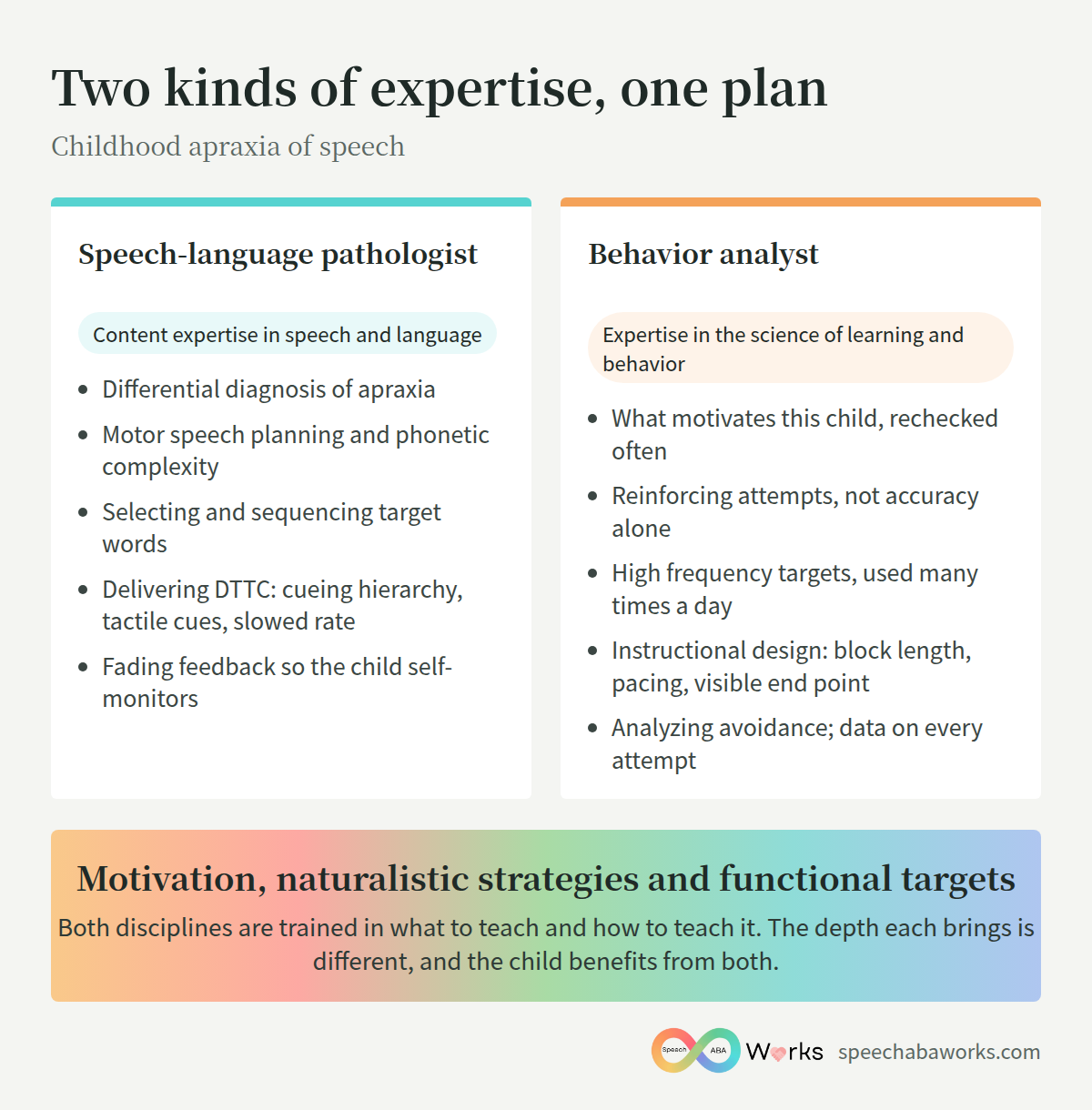
Once motivation, naturalistic teaching strategies and functional targets were built into the sessions, the number of practice attempts increased substantially, and progress on his target words followed. The avoidance behaviors faded without anyone treating them directly, because practice was no longer something worth escaping.
The point of the table above is not that one column matters more than the other, and it is certainly not that either profession is limited to half a job. Both disciplines are trained in what to teach and in how to teach it. What differs is where the depth sits. Years of training in motor speech disorders produce a level of detail about apraxia, target selection and cueing that a behavior analyst has no reason to hold. Years of training in the science of learning produce a level of detail about motivation, reinforcement and how behavior interacts with its environment that a speech-language pathologist has no reason to hold either. Each of us is capable across the whole of a plan. We are simply not equally deep across all of it, and a child benefits when the full depth of both is brought to the same table.
Five ways to change the therapeutic conditions
These apply whether your child’s therapist works in a clinic, a school or your living room.
- Choose targets your child has a reason to say. Functional, high value words earn more attempts than phonetically convenient ones.
- Shorten and repeat. Several short practice blocks across a day will beat one long block, both for motor learning and for tolerance.
- Make the end visible. A set number of turns, a token strip or a simple counter tells the child that the difficult part is finite.
- Reinforce effort. Acknowledge the attempt before correcting the production, and make sure trying is never the thing that leads to more work.
- Keep communication open throughout. Signs, pictures and devices reduce the frustration that fuels avoidance, and they do not slow speech development.
What parents can do at home
Home practice is where most of a child’s total practice actually happens, because a therapist sees your child for an hour a week and you see them every day.
Keep home practice brief and frequent. Five minutes three times a day is more useful than thirty minutes once, and it is far easier to protect.
Practice inside real moments. A target word used to request a snack, greet a sibling or stop a game carries its own motivation, and it also rehearses the skill where it will eventually be needed.
Respond to the message before the production. If your child attempts a word and you understand it, answer it. You can model the clearer version immediately afterwards, but the attempt should work first.
Questions worth asking your child’s team
- How many practice attempts is my child producing in a typical session, and is anyone counting?
- What are the current targets, and why were these words chosen?
- Which treatment approach are you using, and what does the evidence say about it?
- How is feedback being faded as my child improves?
- What is the plan for communication while speech is still developing?
- How will we know within a term whether this is working?
A therapist who is confident in the plan will welcome these questions, and the answers will tell you a great deal about how the sessions are actually running.
Frequently asked questions
What is childhood apraxia of speech?
Childhood apraxia of speech is a motor speech disorder in which the brain has difficulty planning and sequencing the movements needed for speech. The child knows the word and has adequate muscle strength, but the production is inconsistent, effortful and often harder for longer words. It is diagnosed by a speech-language pathologist.
Why does my child refuse speech practice?
Because apraxia practice is genuinely difficult and requires many repetitions, and because behaviors that produce a break from difficulty tend to increase. This is a predictable learning effect rather than a character problem. Changing the targets, the session structure and what gets reinforced usually changes the behavior.
How many repetitions does apraxia therapy need?
There is no single number that fits every child, but studies comparing higher and lower amounts of practice consistently favor the higher, and DTTC guidance suggests at least ten attempts at a given level before moving on. Ask your therapist how many attempts your child is actually completing, because that tends to tell you more than the length of the session does.
What is DTTC therapy?
DTTC stands for Dynamic Temporal and Tactile Cueing, a treatment for childhood apraxia of speech developed by Edythe Strand. The therapist supports the child’s production with touch cues and a slowed rate, then reduces that support step by step across four levels: saying the word together, repeating straight after a model, repeating after a short pause, and finally producing the word independently. The support is adjusted continuously within the session rather than only between sessions, which is what the word “dynamic” refers to.
Can ABA help with childhood apraxia of speech?
Applied behavior analysis is not a treatment for apraxia. Apraxia requires motor speech therapy delivered by a speech-language pathologist, who selects the targets and the technique. Behavioral science contributes the conditions that make intensive practice possible: motivation, reinforcement for effort, and a plan for the avoidance that difficult practice tends to produce.
Will using a device or pictures stop my child from talking?
No. The evidence indicates that augmentative and alternative communication supports speech development rather than suppressing it. A child who can communicate reliably experiences less frustration, participates more, and has more opportunities to practice speech in situations that matter.
How long does apraxia therapy take?
Apraxia typically requires longer and more intensive intervention than a phonological delay, often measured in years rather than months. Progress should still be visible within a term. If it is not, the first thing to review is the number of accurate practice attempts your child is actually completing.
If your child’s apraxia therapy has stalled and you would like a second opinion on the plan, I offer consultations for families and teams. Professionals may find the free Interprofessional Collaboration Checklist useful when a speech-language pathologist and a behavior analyst are working with the same child.
This article is part of a series on how speech therapy and behavior analysis fit together. You may also want to read How Speech and ABA Therapy Work Together and The Order of Intervention Matters.
I share shorter versions of these ideas as @speechabaworks on Threads and Instagram.
This article offers general information and is not a substitute for individual assessment or treatment. The case described is a composite and does not represent an identifiable child.
Selected references
- American Speech-Language-Hearing Association. Childhood apraxia of speech (Practice Portal).
- Strand, E. A. (2020). Dynamic temporal and tactile cueing: A treatment strategy for childhood apraxia of speech. American Journal of Speech-Language Pathology, 29(1), 30–48.
- Strand, E. A., Stoeckel, R., & Baas, B. (2006). Treatment of severe childhood apraxia of speech: A treatment efficacy study. Journal of Medical Speech-Language Pathology, 14(4), 297–307.
- Maas, E., Robin, D. A., Austermann Hula, S. N., Freedman, S. E., Wulf, G., Ballard, K. J., & Schmidt, R. A. (2008). Principles of motor learning in treatment of motor speech disorders. American Journal of Speech-Language Pathology, 17(3), 277–298.
- Murray, E., McCabe, P., & Ballard, K. J. (2014). A systematic review of treatment outcomes for children with childhood apraxia of speech. American Journal of Speech-Language Pathology, 23(3), 486–504.
- Millar, D. C., Light, J. C., & Schlosser, R. W. (2006). The impact of augmentative and alternative communication intervention on the speech production of individuals with developmental disabilities. Journal of Speech, Language, and Hearing Research, 49(2), 248–264.