
“He can say full sentences in the therapy room. The data keeps going up. So why doesn’t he use any of it at home?”
I hear some version of this from parents, teachers and therapists every week. A child has been working hard for months. The goals are being met on paper. And yet nothing much has changed in daily life.
When I look closely at these cases, the problem is rarely the technique. The prompts are fine, the reinforcement is fine, the therapist is skilled. The problem is the order. We started building language complexity before the child had a reason to communicate or a working way to do it. When the order is wrong, everything invested afterwards is discounted.
Everything matters, but not all at once
Here are the goal areas I see on intervention plans for autistic children, often all on the same plan:
- Communication motivation
- Social communication
- Emotional regulation and behavior
- Speech sounds (articulation)
- Understanding language
- Expressive language
- Vocabulary and grammar
- Executive function
- Understanding other people’s minds (theory of mind)
- Play skills
- Group skills
- Academic skills
- Vocational skills
- Cognition
Every one of them matters. But they are not parallel, and a child cannot make real progress on all of them at the same time. The hard part of clinical work is not listing goals. It is deciding which comes first, and which only makes sense once the one before it is in place.
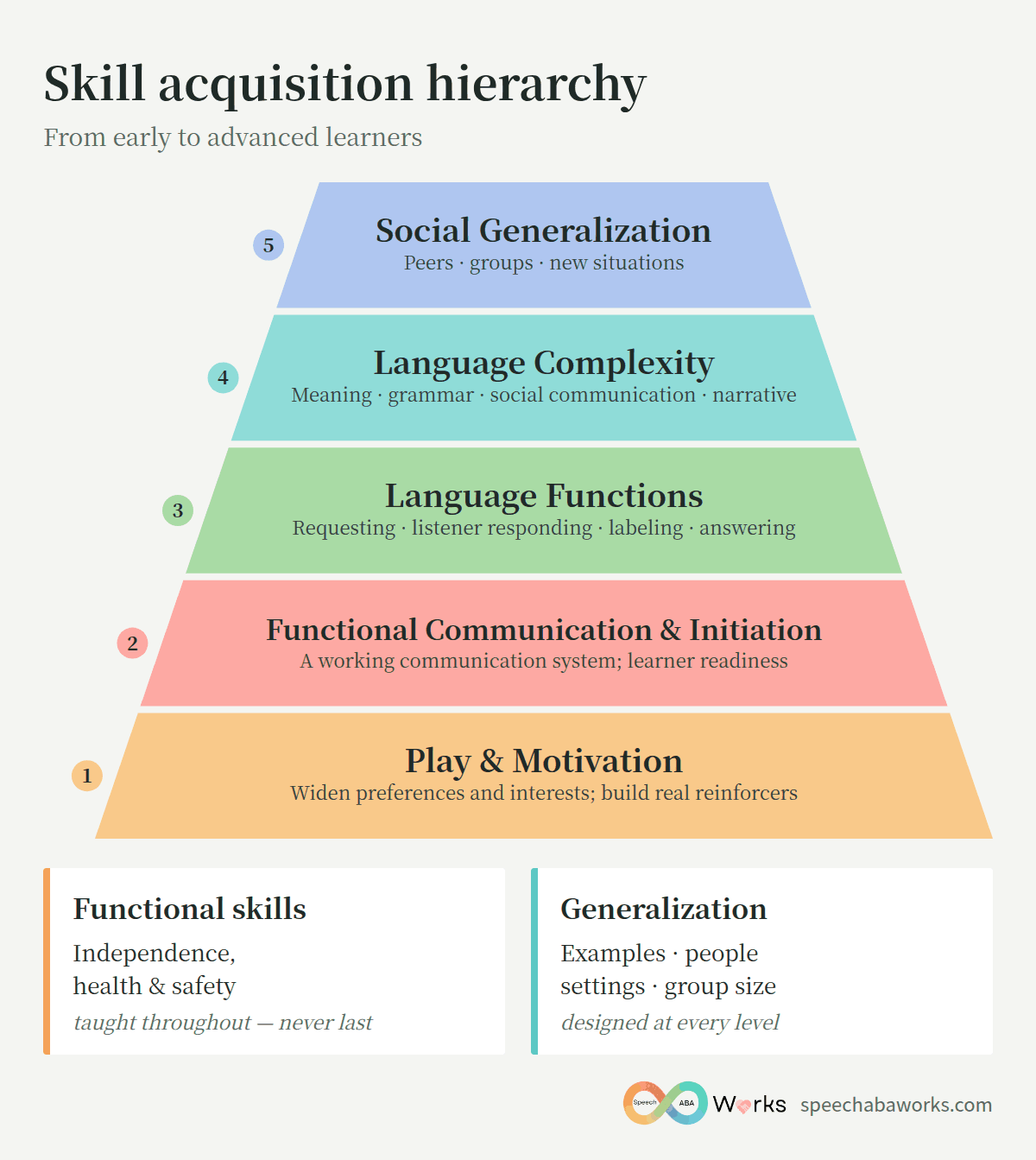
The skill hierarchy: from early to advanced learners
This is the framework I use with teams, from early learners up to advanced learners. I presented it most recently at the 2026 China Hearing and Speech Convention.
Level 1: Play and motivation
The job here is to widen what the child enjoys and to find things that genuinely motivate them. This is not a warm-up before the “real” work. Without motivation, there is nothing for communication to be for.
You will know it is in place when: the child has several things they clearly want, and adults have become part of how they get them.
Level 2: Functional communication and initiation
Next, the child needs a communication system that works for them today — words, signs, pictures or a device — and starts using it on their own. At the same time we build learner readiness: a trusting working relationship in which the child is ready to learn with us.
You will know it is in place when: the child starts communicating without being asked, and can join a short teaching activity with an adult.
Level 3: Language functions
Now we teach language across its main jobs: requesting, responding as a listener, labeling, and answering questions. (I explain these functions in plain language in Verbal Behavior Therapy: A Parent’s Guide.)
You will know it is in place when: the child uses the same words for different purposes, across different people.
Level 4: Language complexity
Only now does it make sense to push hard on complexity: vocabulary and meaning, grammar and sentence structure, social communication, and eventually narrative — telling what happened, in order, in a way a listener can follow.
You will know it is in place when: longer language shows up in real conversations, not only in practice.
Level 5: Advanced social generalization
At the top, the child uses their language flexibly with peers, in groups and in new situations, reading the social context as they go.
Two things that run alongside every level
Functional skills are never last. Independence, health and safety — asking for help, saying “stop”, toileting, crossing a road safely — are taught throughout, at whatever level the child is working.
Generalization is designed at every level, not saved for the end. A skill is only really learned when it holds up across four things:
- Examples — different pictures, objects and situations, not the same flashcard
- People — parents, teachers, peers, not only one therapist
- Settings — home, classroom, playground, supermarket
- Group size — one-to-one, small group, whole class
Why progress stalls when the order is wrong
The most common pattern I see is this: a child completes sentence drills in the therapy room, and then walks out and does not use any of it.
That is not a learning problem. It is a sequence problem. The child has the form of language — the words and sentence structures — without the function: using language to get something done with a real listener.
Here is a quick test I teach teams. When a listener looks confused, does the child stop and add information?
- Yes — function is in place.
- No — the form is there, but the function may not be.
This distinction decides where effort goes. If assessment only measures form, therapy only trains form. Test scores go up; real communication stays the same.
Build the “want to say” before the “how to say it.” Motivation and functional communication first; complexity on top. Reverse the order, and everything that follows is discounted.
What this means for setting goals
- Find where your child is on the hierarchy before choosing goals. Age, grade or diagnosis are poor guides; current skills are good ones.
- Check the level below is solid before investing heavily in the level above. The levels overlap; a child does not have to “finish” one to start the next. But the lower level must work in daily life, not just in sessions.
- Write generalization into every goal — which people, which settings, which examples.
- Keep functional and safety skills on the plan at every stage.
- Set goals as a team from the start. The speech therapist and the behavior analyst should agree on the order together, not bring the other profession in only once progress has stalled.
The same logic applies to school placement. In the New York City classrooms I support, small classes put the weight on safety, behavior and communication; larger classes shift the weight toward group skills and academics. Decide the focus of intervention first, then the placement — not the other way round.
Signs the order might be off
- Lots of sentence practice, but your child rarely asks for things on their own
- Skills appear with one therapist and nowhere else
- Your child resists sessions that used to be fun
- Test scores are rising, but daily life feels unchanged
- The plan has many goals and no clear sense of which matters most right now
If several of these sound familiar, it is worth asking your team where they think your child sits on the hierarchy, and whether the lower levels are really in place.
Frequently asked questions
Why has my child’s speech progress plateaued?
Often because complexity is being taught before motivation and functional communication are secure. The child can produce language in practice but has not yet learned to use it with real listeners. Checking the order of goals is a good first step before changing techniques or adding hours.
Should we work on sentences or on communication first?
Communication first. A child who can reliably ask for what they want, in any form, has a reason to learn longer language. Sentences built on top of that foundation are far more likely to be used in daily life.
Does my child have to master one level before moving to the next?
No. The levels overlap, and a child can work on more than one at a time. The point is that each level depends on the one below it working in real life, so the lower level should never be skipped or rushed.
What does generalization mean?
Using a skill with different examples, different people, in different places and in different group sizes. A word that only appears with one therapist, at one table, has not generalized yet.
How do speech therapy and ABA work on this together?
The speech therapist brings content expertise in language and social communication. The behavior analyst brings expertise in the science of learning and behavior, including teaching sequences, prompting and fading, and data. Both are trained in what to teach and in how to teach it, so this is a difference of depth rather than of role. Agreeing the order together is where collaboration starts. I wrote more about this in How Speech and ABA Therapy Work Together.
If your child’s progress has stalled and you would like a second look at the order of their goals, I offer consultations for families and teams. Professionals may find the free Interprofessional Collaboration Checklist useful for goal-setting meetings.
I share shorter versions of these ideas as @speechabaworks on Threads and Instagram. This article started as a Threads post.
This article offers general information and is not a substitute for individual assessment or treatment.
Selected references
- American Speech-Language-Hearing Association. Social communication (Practice Portal).
- Stokes, T. F., & Baer, D. M. (1977). An implicit technology of generalization. Journal of Applied Behavior Analysis, 10(2), 349–367.
- Sundberg, M. L., & Michael, J. (2001). The benefits of Skinner’s analysis of verbal behavior for children with autism. Behavior Modification, 25(5), 698–724.