
“She is two and a half and she has no words. Everyone keeps telling me to wait. How long am I supposed to wait?”
This is the question I am asked most often, and the honest answer is that waiting is not a plan. Some children do catch up on their own. The difficulty is that nobody can tell you in advance which children those are, and the months spent waiting are months a child spends unable to tell you what they want.
You do not have to choose between panicking and doing nothing. There is a third option, which is to start building the things that come before speech. Those things are useful for every child, whether words arrive next month or in two years, and they are where a good program begins.
What usually brings a parent to this question
Most families arrive at this point with some version of the same picture. The child understands a great deal, or seems to. They take your hand and lead you to what they want. They may have had a few words once and lost them. They get frustrated easily, and the frustration is getting louder as they get older.
Meanwhile the advice is contradictory. One relative says her nephew did not talk until three and is fine now. A doctor says to keep an eye on it. Someone in a parent group says to start therapy immediately. None of these people are looking at your child.
What actually comes before words
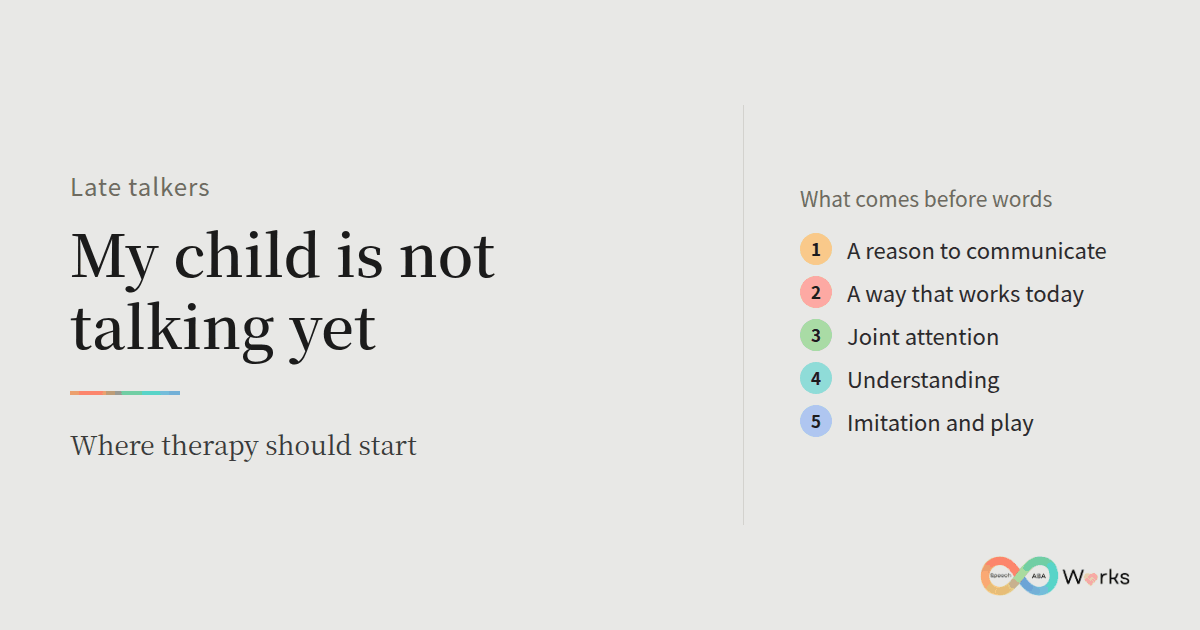
Speech is not the first thing to develop. It sits on top of several other abilities, and when a child is not talking, the useful question is which of those is missing.
A reason to communicate. A child communicates because there is something they want from another person. If a child can reach everything they need, or has learned that nobody responds anyway, there is nothing for language to be for. This is the foundation, and it is the one most often skipped.
A way to communicate that works today. Long before speech is reliable, a child needs some way to make a request that other people understand. That might be a gesture, a picture, a sign, or a device. Without one, a child is left with the tools they have, which are usually crying, grabbing and escalating.
Joint attention. Sharing attention with another person on the same thing: looking where you point, bringing you a toy to show you rather than to get help with it. This is the social ground that language grows in.
Understanding. Words a child understands come before words a child says, usually by a wide margin. A child who follows simple instructions in context has more foundation than a child who does not, even if both are silent.
Imitation and play. Copying actions, then sounds, then words. Play that goes beyond lining things up, into pretending and taking turns.
A child who is not talking may be missing one of these or several. The assessment that matters is the one that works out which.
Why waiting is not the neutral option
Waiting feels safe because it involves no decision. But a child who cannot communicate is not standing still during that time. They are learning something.
They are learning how to get their needs met with the tools available, and those tools are behavioral. Pulling, screaming, throwing and hitting are efficient. They work quickly, and every time they work they become more established. Months of waiting can produce a child who is not only still without words but now has a well practiced set of behaviors that are much harder to change than they would have been earlier.
This is the part families are rarely told. The cost of waiting is not only lost time. It is the behavior that grows in the space where communication should have been.
What a first program should contain
If your child is not yet talking, a good starting program works on the foundations rather than drilling words.
Finding what motivates your child, and protecting it. Before anything else, a therapist should know what your child genuinely loves, and should have become part of how your child gets it. If your child does not want anything you have, there is nothing to communicate about.
Giving your child a way to ask, immediately. Not after six months of trying speech first. A picture, a sign, a device, whatever fits this child now. The goal is that your child can make something happen with a deliberate act of communication, this week.
Teaching requesting before naming. Many programs start by teaching a child to label pictures. Requesting is more useful and usually comes more easily, because it is the function with a built in reward: the child asks for the bubbles and gets the bubbles.
Building understanding in daily routines. Bath, snack, shoes on, out the door. These repeat many times a week and are where comprehension is most efficiently built.
Coaching you. Your child spends far more time with you than with any therapist. A program that does not teach you what to do in those hours is leaving most of its value on the table.
Will using pictures or a device stop my child from talking?
This is the fear that stops many families, so it deserves a direct answer.
No. The research on this question has been consistent for many years, and it points the other way. Children given augmentative and alternative communication, meaning pictures, signs or speech generating devices, are not less likely to speak. If anything they tend to do better on speech measures, not worse.
The reason is straightforward once you see it. A child who can communicate is calmer, participates more, and gets more practice with the back and forth of interaction, which is what speech grows out of. A child with no way to communicate spends a great deal of energy on frustration.
Giving a child a way to be understood now is not giving up on speech. It is removing the thing that is blocking it.
What to ask at your first appointment
- What does my child understand, and how do you know?
- How is my child communicating at the moment, including without words?
- What are we teaching first, and why that rather than something else?
- How will my child be able to ask for things while we work on speech?
- What should I be doing at home, specifically?
- What should we see in three months, and what would tell us this is not working?
A therapist who welcomes these questions is the one you want. The answers also give you a baseline, so that in three months you are judging progress against something rather than against a feeling.
What you can start this week
Put the good things slightly out of reach. Not to frustrate your child, but so that wanting something creates a reason to communicate with you. In sight, needing you.
Wait longer than feels comfortable. Count to five in your head before helping. Many children have simply never been given the silence in which to initiate.
Respond to every attempt. A look, a reach, a sound, a pull. Respond as though your child meant it, because they did. Then model a slightly fuller version.
Narrate less, and pause more. A running commentary is well intentioned, but a child needs gaps in which to take a turn.
Follow what your child is already interested in. Language attaches to what a child cares about far more readily than to what we have decided to teach.
What is NDBI, and why I use it
Everything in the section above comes from a particular way of working, and it has a name. Naturalistic Developmental Behavioral Intervention, usually shortened to NDBI, is the approach I follow. It is worth understanding, because it explains why a good early session often does not look like therapy at all.
NDBI is not one program. It is a family of approaches that share a common structure, set out formally by Schreibman and colleagues in 2015. What they share is a merger of two sciences that were taught separately for a long time: developmental science, which describes the order in which communication normally emerges, and the science of learning and behavior, which describes how a skill is actually acquired, strengthened and carried into new situations. Established programs in this family include the Early Start Denver Model, JASPER, Project ImPACT, Enhanced Milieu Teaching and Pivotal Response Treatment. They differ in emphasis, age range and setting. They do not differ in their foundations.
In practice it looks like this.
Teaching happens inside play and daily routines. Not across a table with a stack of cards. The child’s own activity supplies the moment to teach, which is also the moment the child is most likely to learn.
The child starts the interaction wherever possible. The adult joins what the child has already chosen rather than redirecting them to a planned task. This is the difference between a session that runs on the child’s motivation and one that runs on the adult’s agenda.
The environment is arranged to create reasons to communicate. Putting the good things in sight but out of reach, as suggested above, is this principle in its simplest form.
The reward is the thing itself. A child who asks for the car receives the car, not a sticker or a snack. The consequence is what makes the word worth producing, and an unrelated reward does not teach that.
Turns are balanced. The adult takes a turn, then leaves room for the child to take one. Shared control, rather than the adult directing or the child playing alone.
The adult imitates the child. Copying a child’s actions and sounds back to them is one of the most reliable ways to increase engagement and mutual attention, and it costs nothing.
The adult models slightly above where the child is. One step beyond current ability, not five.
Support is given, then deliberately removed. Help is offered so that the child succeeds, then faded on a plan so the skill becomes the child’s own rather than something that only happens with an adult attached to it.
Goals are individual and progress is measured. This is what separates NDBI from simply playing pleasantly with a child. Targets are chosen from a developmental sequence, data are collected during the session, and the plan changes when the data say it should.
Where a child has little or no speech, a communication system goes in from the start. Minimally verbal children have historically had the weakest outcomes in spoken-only formats. A recent systematic review and meta-analysis combining NDBI with aided AAC found stronger language outcomes than NDBI alone, and no evidence that AAC holds speech back (Pope, Light and Laubscher, 2025). Timing matters here: introducing AAC at the outset is more effective than bringing it in later as a last resort, after a child has already spent months not progressing. This is why the answer earlier in this article was a plain no.
If the suggestions in the previous section felt small, that is deliberate. They are built to fit inside the hours you already spend with your child rather than to be added on top of them, and that is the principle the whole approach rests on.
Frequently asked questions
My 2 year old is not talking. Should I be worried?
Concerned enough to have it looked at, rather than worried. By two, many children have a substantial vocabulary and are beginning to combine words. If your child has very few or no words, an assessment by a speech-language pathologist is reasonable and does not commit you to anything. Waiting to see is common advice, but it is not the same as a plan.
Is my child a late talker or is something else going on?
Only an assessment can answer that, and the useful part is not the label. What matters is the profile underneath: what your child understands, how they are communicating now without words, whether they share attention with you, and how they play. Those tell you what to work on, whatever the eventual diagnosis.
Should we wait until my child is older to start therapy?
Early intervention is easier than later intervention, largely because the alternative behaviors are less established. A child who cannot communicate develops other ways to get needs met, and those become harder to change with time. Starting early is not about panic; it is about working with a smaller problem.
Will using pictures or a device delay speech?
No. The evidence indicates that augmentative and alternative communication supports speech rather than suppressing it. Children who can communicate are calmer, interact more, and get more practice with the exchanges that speech develops from.
What is NDBI?
Naturalistic Developmental Behavioral Intervention is a family of early intervention approaches that combine developmental science with the science of learning and behavior. Teaching happens inside play and daily routines rather than at a table, the child’s own interest sets the moment, and the reward for communicating is the thing the child asked for. The Early Start Denver Model, JASPER, Project ImPACT, Enhanced Milieu Teaching and Pivotal Response Treatment all belong to this family. It is the approach I use.
What if my child understands everything but does not speak?
Strong understanding alongside little speech is a real pattern, and it narrows the question usefully. It may point toward a motor speech difficulty such as childhood apraxia of speech, or toward a child who has no reliable way to take a turn. Either way it is worth assessing rather than waiting out.
Do we need ABA as well as speech therapy?
Not every child does. It is worth considering when communication and behavior are entangled, for example when a child’s main way of asking is to scream or grab, or when a speech program keeps stalling for reasons that are not about language. I wrote about how the two disciplines fit together in How Speech and ABA Therapy Work Together.
If your child is not yet talking and you would like help working out where to start, I offer consultations for families and teams. Professionals may find the free Interprofessional Collaboration Checklist useful when a speech-language pathologist and a behavior analyst are working with the same child.
I share shorter versions of these ideas as @speechabaworks on Threads and Instagram.
This article offers general information and is not a substitute for individual assessment or treatment.
Selected references
- American Speech-Language-Hearing Association. Late language emergence (Practice Portal).
- American Speech-Language-Hearing Association. Augmentative and alternative communication (Practice Portal).
- Millar, D. C., Light, J. C., & Schlosser, R. W. (2006). The impact of augmentative and alternative communication intervention on the speech production of individuals with developmental disabilities. Journal of Speech, Language, and Hearing Research, 49(2), 248–264.
- Schlosser, R. W., & Wendt, O. (2008). Effects of augmentative and alternative communication intervention on speech production in children with autism. American Journal of Speech-Language Pathology, 17(3), 212–230.
- Schreibman, L., Dawson, G., Stahmer, A. C., Landa, R., Rogers, S. J., McGee, G. G., Kasari, C., Ingersoll, B., Kaiser, A. P., Bruinsma, Y., McNerney, E., Wetherby, A., & Halladay, A. (2015). Naturalistic developmental behavioral interventions: Empirically validated treatments for autism spectrum disorder. Journal of Autism and Developmental Disorders, 45(8), 2411–2428.
- Pope, L., Light, J., & Laubscher, E. (2025). The effect of naturalistic developmental behavioral interventions and aided AAC on the language development of children on the autism spectrum with minimal speech: A systematic review and meta-analysis. Journal of Autism and Developmental Disorders, 55, 3078–3099.
- Carr, E. G., & Durand, V. M. (1985). Reducing behavior problems through functional communication training. Journal of Applied Behavior Analysis, 18(2), 111–126.