
“Her scores came back average, so they told me she does not qualify. But she cannot tell me one thing that happened at school. Not one.”
This is the most frustrating conversation in school-age language, and it happens because two true things sit next to each other. The test result is accurate. The parent is also right.
What an average score actually tells you
Standardized language tests are good at what they measure: vocabulary, grammar, following directions. A child who scores in the average range genuinely does know those words and can produce those sentence structures.
What most of them do not sample is discourse, meaning language organized across many sentences toward a purpose. Telling what happened. Explaining why something went wrong. Recounting a film so that someone who has not seen it can follow.
That is a level above the sentence, and it is where this particular group of children comes apart. Vocabulary adequate, grammar adequate, and three minutes of connected language collapses into fragments with the listener left guessing.
The score is not wrong. It is answering a narrower question than the one the parent is asking.
Why it surfaces around third grade
These children often look fine in the early years and appear to fall apart later. They have not changed. The demands have.
Early school asks for labels, short answers and decoding. From roughly third grade, school asks children to read to learn, to write multi-paragraph pieces, to follow a spoken explanation that runs several minutes, and to work in groups where the currency is talk. Every one of those is a discourse task.
Parents describe this as a sudden change. It is usually a mismatch that was always there, becoming visible when the demands finally reach it.
Why a vocabulary test can miss it
Telling a story is not a vocabulary task. The child has to hold a goal across the whole telling, sequence events the listener can follow, decide what matters, track what the listener already knows, and notice when they have lost them.
Liu and de Villiers describe narrative as the meeting point of three dimensions rather than a single skill: language executive function, which organizes the plot and holds the structure together; social communication, which represents what the listener and the characters know and feel; and basic language, meaning vocabulary and syntax.
Narrative sits where all three overlap. A standardized test samples the third thoroughly and the first two barely at all, so a child who is strong in vocabulary and syntax and weak in the other two lands in the average range.
That is the mechanism behind “her scores came back average.”
Form is not function
Language form is the sounds, the words and the sentence structures. Function is getting a message to an actual listener. A child can produce complex sentences and still not communicate.
There is a quick test. When the listener’s face shows confusion, does the child stop and add information? If they do, function is established. If they do not, the form is there and the function may not be.
This decides where intervention goes. If assessment measures only form, therapy will train only form, and the usual result is that standard scores rise while communication does not change.
Social participation is the part nobody tests
Ask an adult how friendships work at eight and they will say shared play. Watch a playground and something else runs alongside it. Children trade accounts. What happened at the party. What the teacher said. Who started it.
Narrative is the currency of that exchange, and a child who cannot hold the floor for thirty seconds of connected telling is left out of it, not through unkindness but because the conversation moves on without them.
This is why “he has friends at school” from a teacher and “she has no friends” from a parent can both be accurate. Proximity is not participation.
It is also why I prefer social participation to social skills as the goal. Social skills suggests a list of behaviors to train. Social participation names what the child is missing, which is a share in what the group is doing.
What the evidence supports
Plainly, and in order of strength:
- Narrative language itself. Well supported. Pico and colleagues found medium effects on narrative production and comprehension in group-design studies.
- Writing. Well supported, and the strongest academic claim. A randomized trial by Gillam and colleagues with 357 at-risk elementary students found significant gains in written narration, maintained at five months.
- Reading comprehension. Conditional. In that same trial there was no significant overall effect immediately after intervention, though grades three and four showed small gains. Anyone promising reliable reading gains is ahead of the evidence.
- Social participation. Supported by clinical rationale rather than by trials with social outcomes.
Four accurate statements are more useful than one impressive one.
What narrative intervention looks like
More structured than “read more stories together,” which is the advice most families get and is not an intervention.
The practices below follow the principles Spencer and Petersen (2020) set out for narrative intervention.
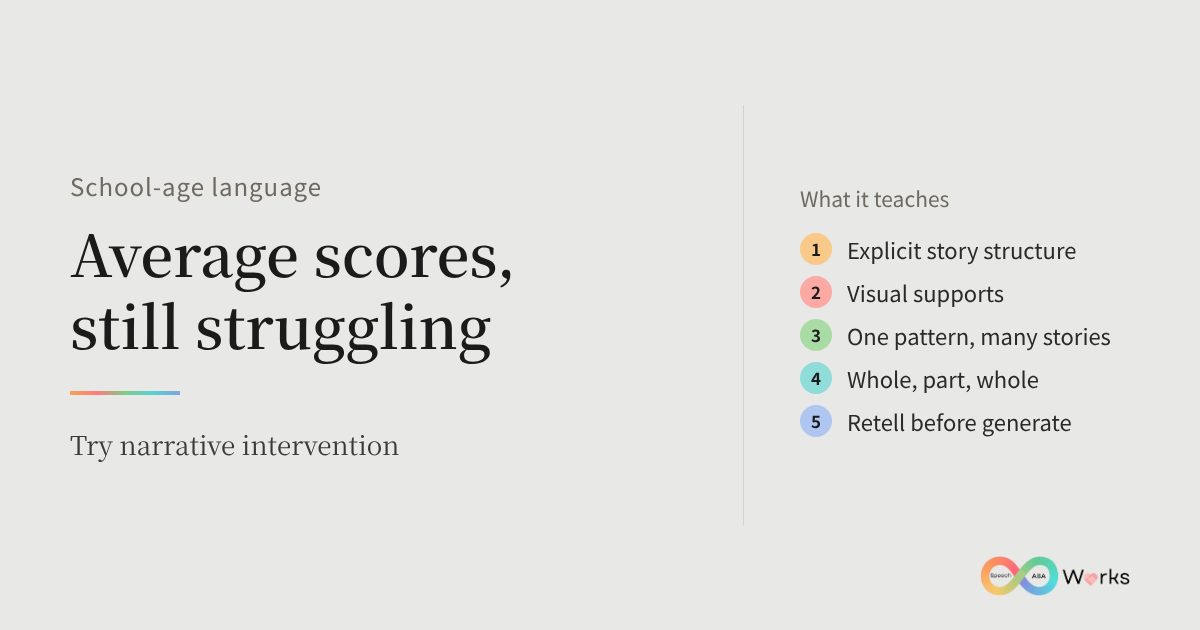
An explicit story structure. The parts of an episode are taught directly: problem, attempt, consequence. Named and reused, not left to be absorbed.
Visual supports. Icons for each story part, so something abstract becomes something the child can point at.
Many examples of one pattern. Different stories sharing a structure, so the child builds a schema rather than memorizing a story.
Whole, then part, then whole. The complete story, then focused work on the weak piece, then back to the whole telling.
Retell before generate. Retelling removes the content load. Original stories come later than people expect.
Where the two professions meet
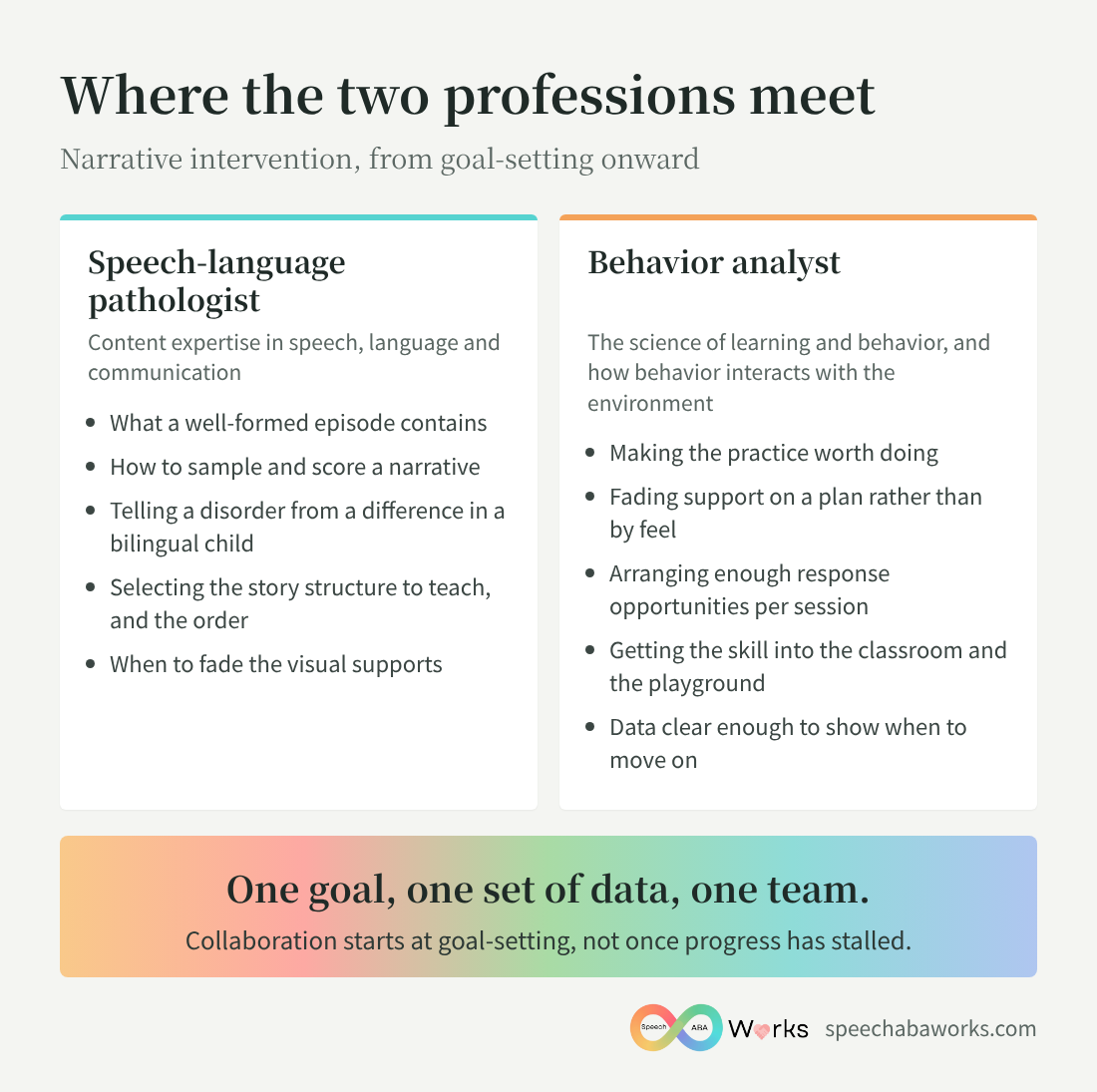
The speech-language pathologist brings content expertise: what a well-formed episode contains, how to sample and score a narrative, and how to tell a disorder from a difference in a bilingual child. The behavior analyst brings the science of learning and behavior: how to make practice worth doing, how to fade support on a plan rather than by feel, and how to get the skill into the classroom and the playground, where the goal actually lives.
Sequence is its own clinical problem. A child who produces the target sentence in the therapy room and never outside it usually does not have an acquisition problem. They have an order problem, from pushing language complexity before motivation and pragmatic function were established. That is also why collaboration has to start at goal-setting rather than arriving once progress has stalled.
One goal, one set of data, one team.
If you are the parent
The eligibility meeting is where this gets decided, so go in with specific questions.
- Was a language sample taken, and was a narrative sample part of it?
- How was it scored, for story structure as well as sentences?
- My concern is that she cannot tell me about her day. Which measure addressed that?
- If she does not qualify for direct service, what is the plan for the classroom?
An average composite is a summary of several subtests. Ask to see the parts. A child can sit on the average line while scoring well below it on the pieces that matter most for discourse, and that is invisible in the headline number.
You are not asking anyone to bend a rule. You are asking whether the thing you are worried about was measured at all.
If you are the school SLP
You already know this child, probably several, probably on a caseload with no room.
Narrative is efficient, because it is one of the few targets serving oral language, writing and social participation at once, which matters when you are justifying minutes. Narrative goals are also straightforward to write measurably, because story structure gives you countable elements rather than a vague “improves expressive language.”
If you are starting, start with retell of a short model story with a visible structure, score the parts, and work on the part that is missing.
Frequently asked questions
My child passed the language test. Why is she still struggling?
Most standardized language tests sample vocabulary and sentence-level grammar, not extended discourse. A child can have adequate words and sentences and still be unable to organize a three-minute account. The score is accurate and your concern is accurate; they are about different things.
What is narrative intervention?
A structured approach to teaching children to tell and understand stories. Story parts are taught explicitly, usually with visual icons, practiced across many examples sharing the same structure, and moved gradually from retelling to generating. It is used from preschool through high school.
Does narrative intervention improve reading?
Partly. In a large randomized trial there was no significant overall effect on reading comprehension immediately after intervention, though grades three and four showed small gains. The effect on writing was clearer and held at follow-up. Treat improved writing as the stronger expectation.
My child has friends at school. Is this still relevant?
Possibly. Being near other children is not the same as taking part in what they are doing. If your child plays alongside peers but cannot join the exchange of accounts that older children run on, that gap tends to widen rather than close.
Is this the same as social skills training?
No. Social skills programs teach discrete behaviors such as greetings or turn-taking. Narrative intervention teaches the language that participation runs on. A child who cannot sustain connected talk will not be carried by a greeting script.
If your child scores in the average range and you are still worried, or if you are a clinician with a caseload of children in this profile, I offer consultations for families and teams. Professionals may also find the free Interprofessional Collaboration Checklist useful when a speech-language pathologist and a behavior analyst are working with the same child.
I share shorter versions of these ideas as @speechabaworks on Threads and Instagram.
This article offers general information and is not a substitute for individual assessment or treatment.
Selected references
- Pico, D. L., Prahl, A. H., Biel, C. H., Peterson, A. K., Biel, E. J., Woods, C., & Contesse, V. A. (2021). Interventions designed to improve narrative language in school-age children: A systematic review with meta-analyses. Language, Speech, and Hearing Services in Schools, 52(4), 1109–1126.
- Gillam, S. L., Vaughn, S., Roberts, G., Capin, P., Fall, A.-M., Israelsen-Augenstein, M., Holbrook, S., Wada, R., Hancock, A., Fox, C., Dille, J., Magimairaj, B. M., & Gillam, R. B. (2022). Improving oral and written narration and reading comprehension of children at-risk for language and literacy difficulties: Results of a randomized clinical trial. Journal of Educational Psychology. Advance online publication.
- Spencer, T. D., & Petersen, D. B. (2020). Narrative intervention: Principles to practice. Language, Speech, and Hearing Services in Schools, 51(4), 1081–1096.
- Liu, X. L., & de Villiers, J. (2025). The “Language-Social Communication-Cognition” three-dimensional language assessment and intervention model: Clinical application of theory of mind in language assessment and intervention. Boao Bethel International Medical Center.