
“He eats six things. All of them beige. If I put anything else on the plate he leaves the table.”
Most children go through a narrow phase. A smaller group does not come out of it, and for those families the question is not how to get one more bite in tonight. It is whether something is wrong, and what a safe program actually looks like.
Start with the part that is not behavioral
Feeding is a medical issue before it is a behavioral one. Choking risk, reflux, constipation, dental pain, enlarged tonsils and oral-motor differences all look the same from the outside: the child refuses food. None are treated by a reward chart, and pushing bites past an untreated medical cause can do harm.
The consensus definition of pediatric feeding disorder, set out by Goday and colleagues, names four domains at once: medical, nutritional, feeding skill and psychosocial. A child can have difficulty in any combination of them, which is the argument against any single-discipline answer. So the first step is a pediatrician, plus a swallow and oral-motor evaluation where indicated. Everything below assumes that step has happened.
Picky eating, ARFID, and sensory eating in neurodivergent children
These three get used interchangeably and they are not the same thing. The difference decides whether you need a program at all.
Ordinary picky eating. Common, usually a phase, not harmful. The list is short but stable or slowly growing, the child grows well and eats at school or at a relative’s house, and mealtimes are not consistently distressing. This group needs patience and low pressure, not treatment.
ARFID. A mental health diagnosis, and the threshold is harm rather than variety: persistent failure to meet nutritional needs plus at least one of significant weight loss or faltering growth, nutritional deficiency, dependence on supplements or tube feeding, or marked interference with psychosocial functioning. Weight loss is not required, so a child can be a healthy weight and still meet the threshold. Golding and colleagues describe three drivers, and a child may show more than one: lack of interest in eating, sensory sensitivity, and fear of aversive consequences, often after choking, vomiting or pain. It is not driven by concern about body shape, which separates it from anorexia. Speech-language pathologists do not diagnose ARFID; they screen, assess feeding skill, treat and refer.
Sensory eating in neurodivergent children. Sensory-based selective eating is very common in autistic children, and ARFID does have a particular association with autism, but sensory eating is not automatically ARFID. The question is still harm. An autistic child with a narrow but nutritionally adequate diet, who eats comfortably and is growing, does not need an intervention to make their eating look typical. Variety is not the goal; nutrition, safety and participation are. Where it does cross the line, the sensory difficulty is real rather than a matter of willingness, and that changes what the program should look like.
The accepted foods are rarely random
Line up the foods a child does eat and look at them as a clinician rather than a parent, and a pattern usually appears. They are often the foods requiring the least oral work: dry, uniform, predictable, breaking apart the same way every time. Or they share a sensory property, a color, a temperature, a brand of packaging. That pattern tells you whether this is a skill problem, a sensory problem or both, and what the next food should be. It also reframes the child. A child eating six foods is not being difficult. They have found the six that work.
Eating is the last step on a long ladder
In the SOS Approach to Feeding, developed by Kay Toomey, swallowing is the end of a sequence rather than the task. The ladder runs roughly: tolerate the food on the table, interact with it, smell it, touch it, taste it, and finally eat it. Stopping anywhere on it is real progress, and a child who licks a food and spits it out has done something significant.
Accepting new textures also requires oral-motor skill and sensory processing to develop together. A child is sometimes willing but not yet able, and sometimes able but overwhelmed, which is why “just try one bite” so often fails.
One change at a time
For a child with a short list, protecting the list matters as much as extending it, because pushing too hard can cost you foods that were previously safe. So change one property at a time: portion, shape, temperature, brand or plate, but only one, and only on a food already accepted.
Food chaining, described by Fraker and colleagues, makes this systematic. Move from a food the child eats to one differing in a single property, then another, so no step is big enough to trigger refusal. Whole slice of bread, then half, then quarter, then lightly toasted, then thinly spread. Watch also for food jags, where a child eats one food exclusively then abruptly drops it; small, frequent variation helps prevent them.
Connection first, demands second
For a child with ARFID, particularly the fear-driven and sensory-driven presentations, the meal itself has become the demand. Everything at that table asks something of them, and most of it asks the one thing they cannot currently do.
Every demand that produces escape teaches that escape works, and the list narrows a little further. There are two ways to break that cycle: block the escape, or lower the demand. Blocking escape is where holding, forced bites and manufactured hunger come from, and I do not use them. Lowering the demand reaches the same analysis from the other end, and it is what the child can actually tolerate.
Five things carry most of the work.
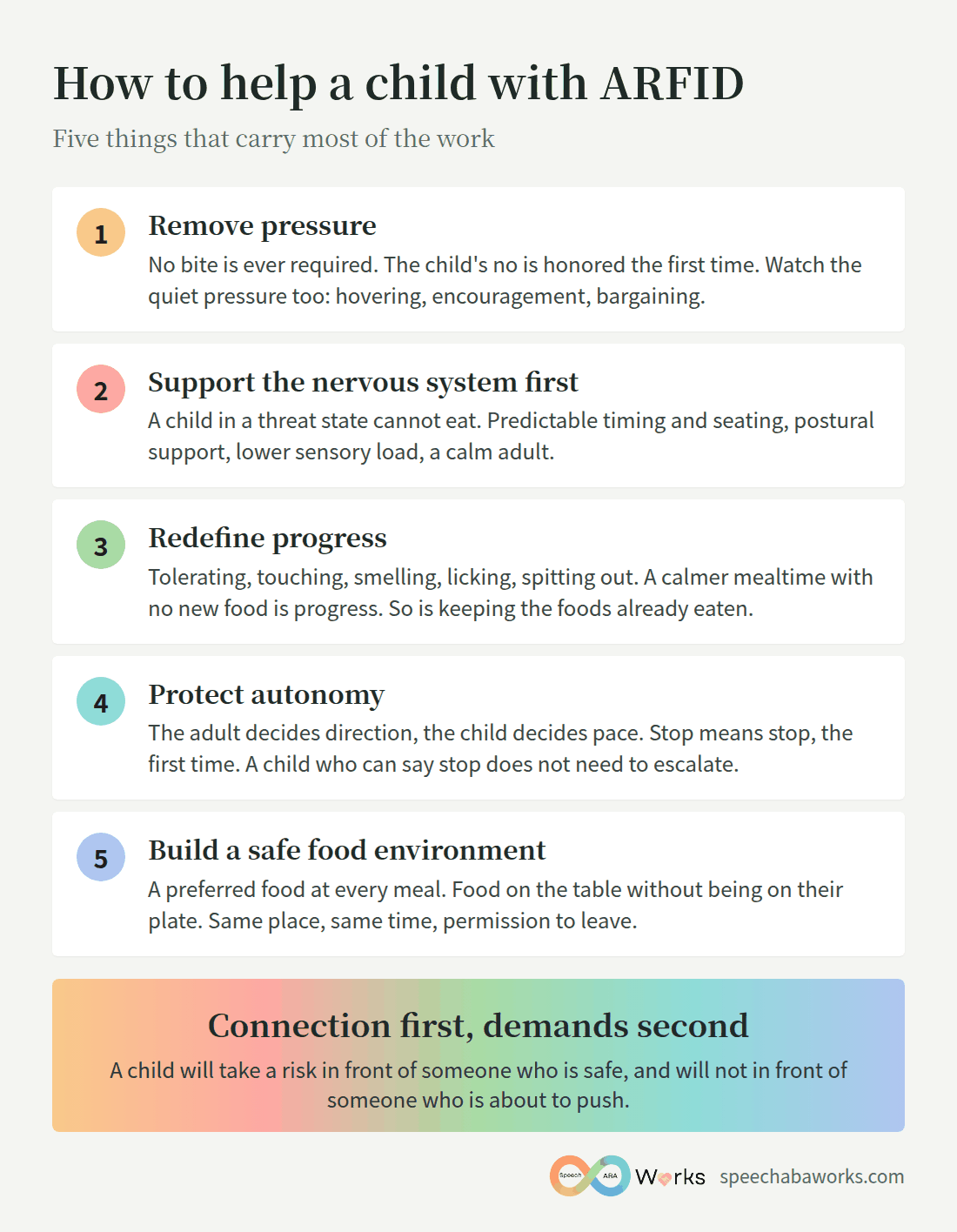
1. Removing pressure. No bite is ever required, and the child’s no is honored the first time rather than the third. Notice the quiet pressure too: hovering, bargaining, praise that asks for more. Change the grammar as well, because “do you want to try it?” hands the child a refusal and “let us eat this together” does not.
2. Supporting the nervous system first. A child in a threat state cannot eat, and no technique overrides that. Appetite and the willingness to explore depend on a body that is not braced, so regulate before you present food: predictable timing and seating, postural support, lower sensory load, and a calm adult. ARFID is also associated with interoceptive differences, so hunger and fullness signals may be genuinely hard to read.
3. Redefining progress. If swallowing is the only thing that counts, almost every meal is a failure and the family gives up. Any step on the ladder counts, a calmer mealtime with no new food counts, and so does keeping the foods already eaten. Praise the step rather than the child, so “you put it on your lip” instead of “good boy.”
4. Protecting autonomy. The adult decides direction, meaning what is offered and in what sequence. The child decides pace. Stop means stop, in words or with a gesture, the first time it is used. This is not only kindness: a child with a reliable way to say stop does not need to escalate, which removes the escape cycle at its source.
5. Building safe food environments. A preferred food at every meal, including the working meal. Food on the table without being on their plate, so exposure happens without expectation. The same place, roughly the same time, and permission to leave. Adults eating the same food alongside them, because modeling does more than instruction.
Connection holds all five together, and it is not sentimentality. A child will take a risk in front of someone who is safe and not in front of someone about to push. Pressure and trust compete for the same chair.
Two kinds of expertise, one plan
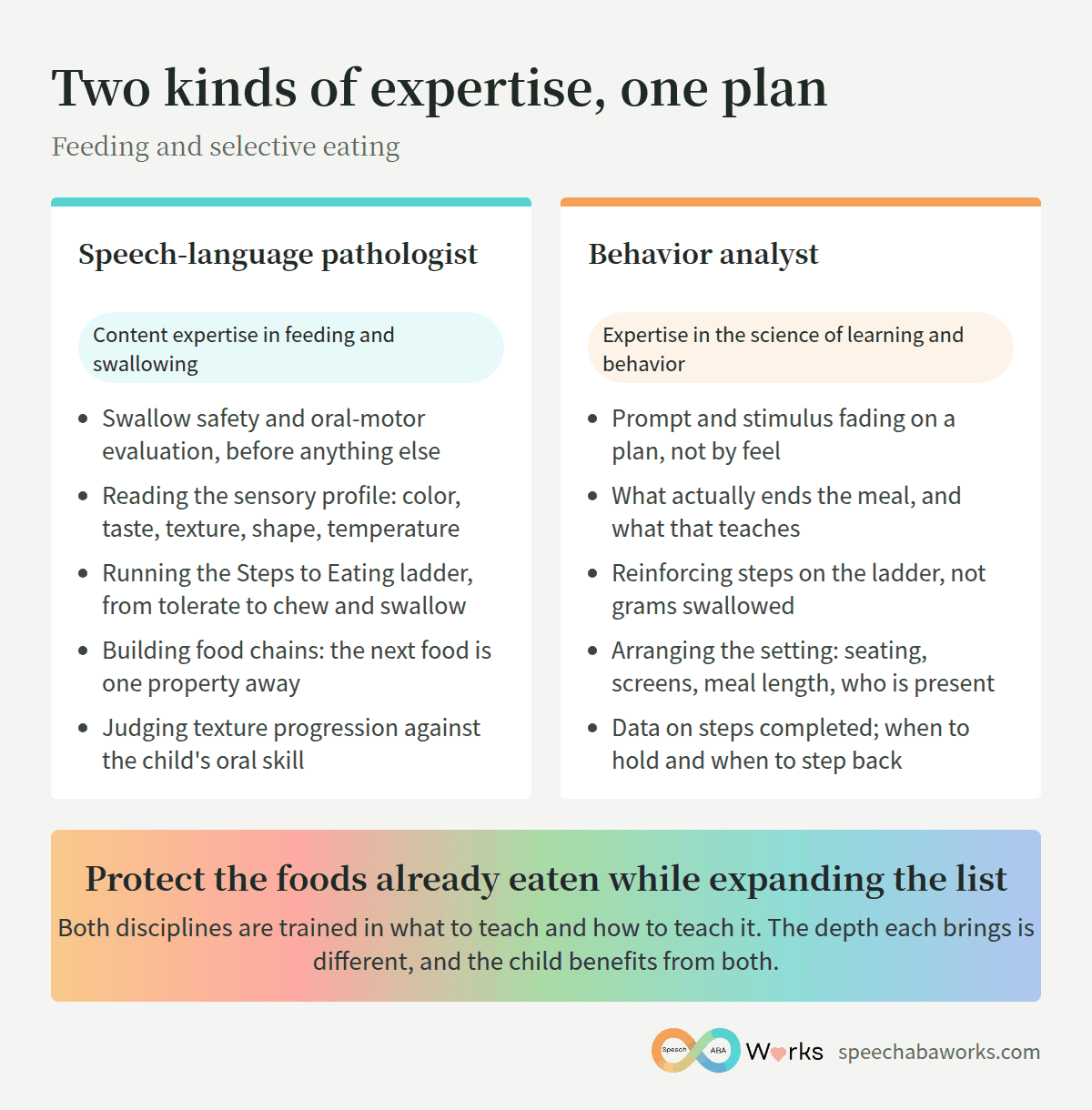
The speech-language pathologist owns swallow safety, oral-motor skill, the sensory profile and texture progression, and designs the chain so the next food is genuinely one step away. The behavior analyst owns the learning conditions: prompt and stimulus fading on a plan rather than by feel, reinforcing steps on the ladder rather than grams swallowed, and data clear enough to show when to hold and when to step back.
Some limits belong in the plan in writing, whoever is running it: no holding the child, no forced bites, no withholding preferred foods to manufacture hunger. Distress is information, not an obstacle to push through.
What the evidence does and does not say
Feeding is a field where confident claims outrun the research, so plainly: the SOS Approach and food chaining are widely used, clinically sensible and taught across the profession, but their published evidence base is thinner than their popularity suggests. Behavioral feeding intervention has the stronger controlled literature, and for ARFID specifically the treatment research is young. None of that means do nothing. It means a good program borrows the developmental and sensory framing from one tradition and the teaching precision from the other, and that anyone promising a fixed result on a fixed timeline is ahead of the evidence.
What you can do this week
Write down what he actually eats, for a week, including what was offered and refused. More useful to a clinician than any description from memory.
Look for the pattern. Color, texture, temperature, shape, brand, packaging. What do the accepted foods have in common?
Stop wiping after every bite. It interrupts the meal and teaches that mess is bad, which raises anxiety around food.
Frequently asked questions
How do I know if this is normal picky eating?
Look at cost rather than count. If growth, weight, nutrition or the ability to eat outside the home are affected, or if mealtimes are consistently distressing, it is worth an assessment. If your child has a short but stable list, is growing well and eats comfortably, watchful waiting is reasonable.
Should I just not offer anything else until he is hungry enough?
No. Withholding food to create hunger is unsafe with a child who has a restricted intake, and it does not address why the list is short. With genuine sensory or skill difficulty, hunger does not produce the missing ability.
Is ARFID the same as autism?
No, though they co-occur often enough that sensory-based food restriction is common in autistic children. ARFID is a separate diagnosis and can occur in children who are not autistic.
My child used to eat more. Why has the list shrunk?
Lists narrow for several reasons: a choking or vomiting episode, illness or pain, a food jag ending, or pressure at mealtimes that made eating aversive. A shrinking list is worth taking seriously, because it tends to continue.
Can we do this at home without a therapist?
Partly, and the order matters. Start with your child’s doctor, because nothing else is safe to build on until the medical causes are ruled out. After that, the most traction usually comes from a team that mixes both traditions: a speech-language pathologist for swallow safety, oral-motor skill and texture, and someone trained in behavior for the teaching conditions and the data.
But you do not have to wait to begin. Removing pressure, protecting autonomy, redefining what counts as progress, and food chaining within textures your child already manages can all start at the next meal. They cost nothing, and they usually change the atmosphere at the table faster than anything that happens in a clinic.
If you have concerns about swallowing safety, repeated coughing or choking during meals, weight loss or nutrition, speak to your child’s doctor. Nothing in this article is a substitute for an individual assessment.
If your child’s food list is short and you want help working out what the pattern is, I offer consultations for families and teams. Professionals may also find the free Interprofessional Collaboration Checklist useful when a speech-language pathologist and a behavior analyst are working with the same child.
I share shorter versions of these ideas as @speechabaworks on Threads and Instagram.
Selected references
- Goday, P. S., Huh, S. Y., Silverman, A., Lukens, C. T., Dodrill, P., Cohen, S. S., Delaney, A. L., Feuling, M. B., Noel, R. J., Gisel, E., Kenzer, A., Kessler, D. B., Kraus de Camargo, O., Browne, J., & Phalen, J. A. (2019). Pediatric feeding disorder: Consensus definition and conceptual framework. Journal of Pediatric Gastroenterology and Nutrition, 68(1), 124–129.
- Golding, S., Slevin, H., McCulloch, A. S., Birch, E., Nikiforovski, A., Sharif, N., Cano Ochando, D., & Elvins, R. (2026). Avoidant/restrictive food intake disorder in children and young people: An update for clinicians. BJPsych Advances. Advance online publication.
- Fraker, C., Fishbein, M., Cox, S., & Walbert, L. (2007). Food chaining: The proven 6-step plan to stop picky eating, solve feeding problems and expand your child’s diet. Marlowe & Company.
- Toomey, K. A. SOS Approach to Feeding. (Clinical training program; see sosapproachtofeeding.com.)